Spotlight
Building a Sustainable Future: The Role of Professionals in Nigeria’s Built Environment
18 March 2025
18 March 2025
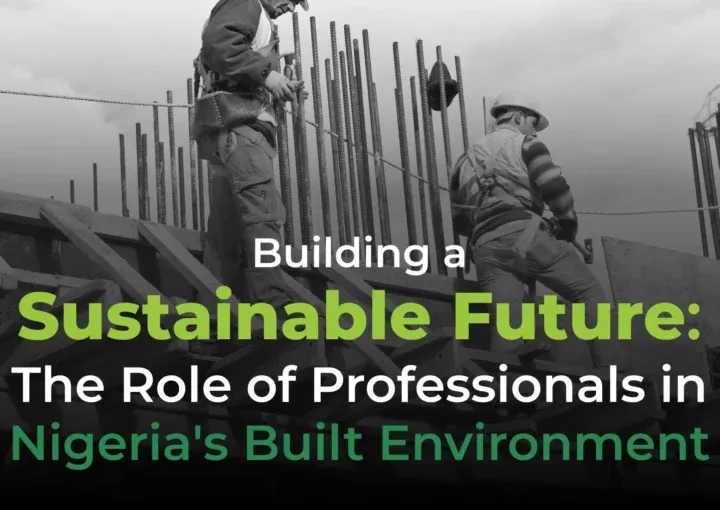
With mankind on a trajectory towards an untenable situation on a finite planet, a radical acceleration is needed in society’s direction towards sustainability. Instead, progress is slowing. There is a concentration on short-term returns and limited change, with small steps being promoted to the public as much greener than they actually are. A defining component of a profession is to work for the common good. However, Nigerian built environment professionals seem to have been driven into a space in which they are expected to apply their skills with little question or reflection about the risks of ‘business as usual’. If professionals are to act as a positive catalyst and influence on wider society, then their practices and organizations will need to articulate more clearly how their independent protection of the public good will bring benefits. Changes to professional practice and professional organizations must focus on outcomes and long-term issues.
The last decade has seen tremendous maturity in building professionals’ understanding of sustainability. However, sound advice from building professionals is not being sought on how the built environment needs to evolve. Building-related institutions in Nigeria now require their members to respond to the sustainability agenda, but society no longer sees professionals as relevant, or impartial. Instead of seeking expert professional input, many politicians will now turn to successful business people, ideally ones who also have media exposure. On sustainability matters, the media itself is also much more likely to turn to a ‘personality’ or a representative of a pressure group than to a professional.
Governments (Federal, States and Locals) defines the balance between social good and the market, and sets the general framework in which business operates. Unfortunately, the Nigeria government (particularly its civil service) has progressively de-skilled itself and depends on outsourcing to businesses. With a lack of moderation by independent professional expertise, the support and advice obtained by government tends to have implicit bias towards corporate objectives. These objectives necessarily include short-term returns to satisfy institutional shareholders. The longer-term needs of sustainability tend to be squeezed out, and society is short-changed. Fee competition forces small businesses to follow suit. Academe also follows funding streams that use tick-box criteria and ranking systems. Where it engages with industry, short-term objectives predominate.
A society rapidly leaving behind one social and business framework, seeking to find an alternative. China’s engagement with capitalism is delivering increasingly uneven distribution of prosperity, from the super-rich to the super-poor. The guiding traditions of Confucius with its support for the common good, acceptance of one’s place in society and a balance with the natural world have been set aside as vestiges of a past era. Sadly, Western professionals, as handmaidens of the corporations, are reinforcing the illusion that this new model offers a route to various possible utopias.
To hold the social fabric together, China’s government is realizing that it needs a process of defining limits and standards for business. China’s government has recognized that much corporate Western advice does not benefit society as a whole, and that longer-term sustainability and prosperity will require significant constraints on resource use.
China’s new 12th Five Year Plan identifies a raft of Green Technology sectors intended to address China’s natural resource limitations. The intention is to guide local industry to develop new green products with an eye to the longer term, coupled with proactive drives to stimulate local demand. This raises a crucial question: is there an alternative to such unilateral action more suited to a democracy and society with individual choices, but that can align longer-term needs with shorter-term gains?
There are clear parallels between the UK’s Industrial Revolution in the late 18th and early 19th centuries and what China now faces as it grapples with the implication of its own industrialization: big business as the driver for economic growth; large-scale consumption, pollution and exploitation of labour; mass migration; and breakdown of the previous largely rural and almost feudal society.
In the UK in the 18th and 19th centuries, professional institutions directly emerged in response to the pressures of the Industrial Revolution. The impartiality of the emerging professionals allowed technical standards and professional judgement to be made available for adoption by government and thereby given enforceable status. The role of the professions as mediators was formalized and embedded in their constitutions.
There is a natural gap between social development and prosperity generation. When Nigeria went through a similar process, professionals emerged to provide a key connection between social, economic and environmental progress. Now, with decisive action on the environment becoming essential and social development largely stalled, the Nigerian government turns directly to business for solutions and sees professionals as largely irrelevant. There are several reasons why the role of professionals has eroded:
Over the past century, corporations have progressed to become multinational vendors that wish to convince the populace that the key to well-being is more consumption. But corporations have a fundamental flaw: they are dominated by short-term financial performance. Corporations and their public relations agencies are continually refining techniques of business image risk management, using layers of ‘greenwash’ to produce an illusion of major progress towards sustainability whilst keeping underlying change to a minimum.
The current Nigerian political debate appears to frame a dichotomy between environmental sustainability and prosperity. This naïve, short-term view is propagated by politicians’ lack of sufficient knowledge and technical grounding. Over recent decades, by following a policy of outsourcing, government has also erased direct access to the impartial technical and business expertise it once had within its civil service.
What is really lacking is confidence in a coherent way forward. There are alternative ways of giving politicians confidence by drawing on a wider range of stakeholders, and built demonstrations show that radical change is not that difficult.
Due to the increasing pace of communication and information, politicians are now expected to have instant responses to any question the media raises. Conditioned by a media that prizes brevity and simplicity of presentation, wider society is progressively losing the ability to interrogate information for the motivations behind the information sources.
Today’s Nigeria professional institutions were formed as a response to a need for independent advisors empowered to balance the needs of business with the collective good of society. Over the intervening period the professions have been slow to respond to change. Built environment professionals operate in fragmented institutions, none of which has the ability to provide the rapid, coherent, well-grounded responses that wider society needs.
With politicians struggling to balance short-term profits of corporations with longer-term social good, and the media unable to engage the public in meaningful debate beyond sound bites, there is a place for clear vision about the way forward. Building professionals are now starting to be judged critically on the match between design predictions and actual operational performance, and must respond.
If building professionals are to make a meaningful contribution in society and to sustainability, they must fill the large communications gap in society’s appreciation of sustainability, and develop reasoned and rounded views about the complex world in which we work. A new approach to professionalism is needed. This would entail:
The key questions are whether built environment professionals are ready and willing to engage with these challenges; and whether their institutions can adapt accordingly.
For more information or to explore how CIOB NIGERIA HUB can support your profession and businesses, please contact our team: info@ciobnigeriahub.org or call +2347064420135
Whether you're a seasoned professional, a student building your future, or an organisation raising standards, CIOB Nigeria Hub welcomes you.